
02 - PATHS STEEPED IN HISTORY AT ESCORNALBOU
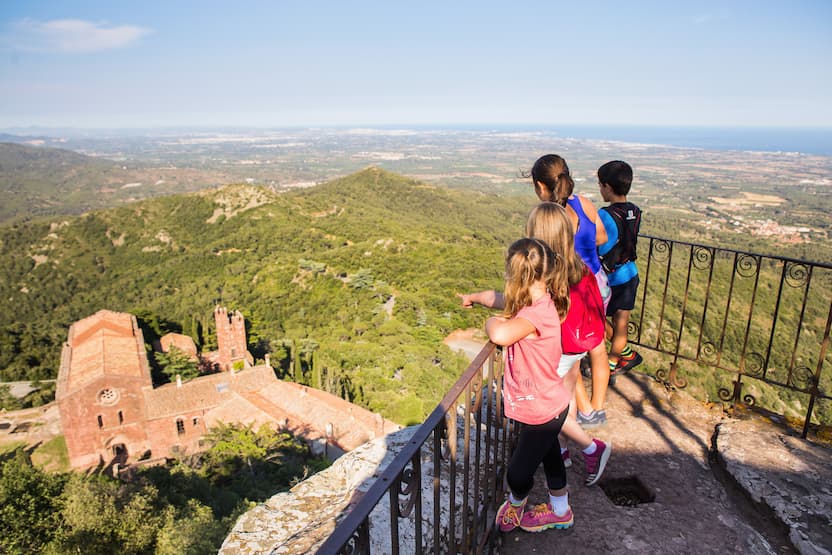
The Escornalbou castle-monastery stands on one of the last hills of the coastal mountains, facing the sea with a privileged view over the villages at its feet. Made up of a fortress, a church dedicated to Saint Michael and an Augustinian canonry, it was the nerve centre from which the extensive territory of the barony of Escornalbou was controlled, comprising the lands of l'Argentera, Colldejou, Duesaigües, Riudecanyes, Vilanova d'Escornalbou, la Torre de Fontaubella and Pradell de la Teixeta. In the 20th century it was restored by the diplomat Eduard Toda of Reus, who turned it into a stately residence, now owned by the Diputació de Tarragona and open to visitors. Walking its old cobbled paths is a real journey through history...
- Distància
- 7 km
- Desnivell
- +390 m
- Durada
- 2 h 15 min
- Dificultat
- beginner level - green
- Senyalització
- Baix Camp path network signposting
Description
That is precisely what we propose here: following the monks' old footsteps from l'Argentera to the castle along the old cobbled path. The boldest can climb to the hermitage of Santa Bàrbara, at the highest point, or head to the Font del Sarraí, the setting of the ballad of the castellan's wife and the son of the local emir. From there, you descend through a pleasant holm oak wood to the village of Duesaigües and return to l'Argentera along the old cart track, among farmland.
Technical information
Distance: 7 km
Elevation gain: +390 m
Duration (approx.): 2 h 15 min
Difficulty level (colour): beginner level - green
Signposting: Baix Camp path network signposting
Riudecanyes, in the very heart of the Baix Camp, at the foot of the Serra de l'Argentera, is another of the distinctive villages of the Costa Daurada, notable for its reservoir and the Escornalbou Castle-Monastery, a spectacular stately mansion of the early 20th century, built over the remains of two medieval buildings: the monastery of Sant Miquel and the castle, itself built on a Roman-era fortification. Of the old monastery only the Romanesque church survives, built between the 12th and 13th centuries, with a single nave; the chapter house, with stained-glass windows showing the Tau symbol of Tarragona (the Greek letter symbolising the T of Saint Thecla, patron saint of Tarragona); the cloister and the crypt. Of the Castle-Monastery, now a stately home that belonged to the diplomat, Egyptologist and philanthropist Eduard Toda, the library stands out. You can also visit the Blue Room, the rooms on the first and second floors, the dining room, the ceramics room and, finally, the wine cellar.
It is a circular mountain route created by the friars themselves when building the monastery. Besides spectacular views of the Costa Daurada coast, halfway along you can stop at the hermitage of Les Tres Verges (the Three Virgins), built around 1818 in the shelter of the mountain rocks.
Standing on the summit of the mountain, it was built in the 18th century and consecrated to Saint Barbara, protector against lightning and storms. With no worship held inside, it is now a magnificent viewpoint from which to contemplate and admire much of the Camp de Tarragona and the Costa Daurada.