
10 - THE CASTLES OF THE GAIÀ
The River Gaià and its valley were a frontier territory between Christians and Muslims for a good two centuries and, in fact, hold the highest density of medieval defences in the country. Selmella Castle was the most advanced, to the west, ahead of the rest of the castles such as Saburella, Vallespinosa, Querol, Santa Perpètua de Gaià and others. Today, this is a sparsely populated and wild area, with fortresses and panoramic views that will surprise walkers.
- Distància
- 13 km
- Desnivell
- +440 m
- Dificultat
- intermediate level - blue
Description
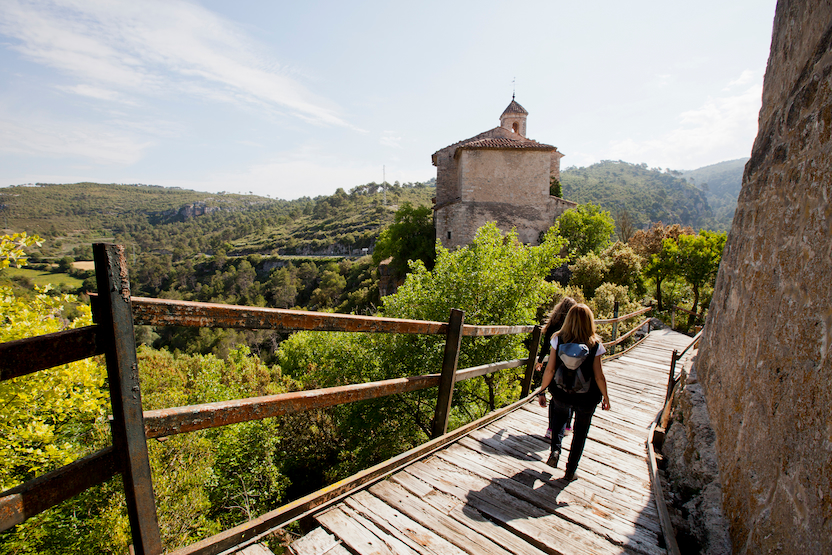
The route starts from the small village of Vallespinosa, built in the shelter of its castle. Skirting the Serra del Puig Cristià you reach the hamlet of Selmella, crowned by its castle, now in ruins. In a strategic position, it has wide views, from Montserrat in the north to the sea and the farmland of Tarragona. From here you reach the Puig de les Agudes without any major climbs, and begin the descent towards the hamlet of Saburella and its castle. Of note are a section of the wall, one of the three towers, which is still fairly intact, and the dovecote, where carrier pigeons were bred. On the way back to Vallespinosa, among the vegetation, you can make out the remains of the old Molí del Racó mill, in the gully of the Comadevaques hollow.
Technical information
Distance: 13 km
Elevation gain: +440 m
Approx. duration: 4 h 10 min (walking time)
Difficulty level (colour): intermediate level - blue
Did you know that the River Gaià rises near Santa Coloma de Queralt and that a route of castles begins here, following the whole course of the river until it flows into the Mediterranean? Two ends of the Costa Daurada! Santa Coloma de Queralt, in the Conca de Barberà, preserves part of its medieval wall, which we recommend visiting. The Castle of the Counts of Queralt is also interesting, especially its 11th-century Keep, now restored to host cultural activities.
Going down the River Gaià from Pontils Castle, also known as "el Castellet", and from Santa Perpètua de Gaià, now an uninhabited village but one that preserves a 15-metre-high watchtower, you will find Saburella Castle, in a good state of preservation and perched on top of a hill; and Selmella Castle, declared a Cultural Asset of Interest, which preserves walls, part of the curtain wall and the base of the tower.
A small village of about forty small houses rising along narrow, winding streets. At the foot of the walls of the old Vallespinosa Castle you can see the remains of the old Romanesque church of Santa Maria. The present church, standing in the middle of the village square and dedicated to Saint James, has a single nave and was built in the modern era. The origins of the village go back to 1030, when the castle was built, which belonged to the Cervelló family from the time the place was conquered.