
In the footsteps of the ancient settlers of the Priorat
We have selected this route created by Turisme Priorat because it lets you delve into the most distant past of this part of the Priorat, when, some three thousand years ago, those who were probably the first miners of the comarca lived sheltered on a hilltop on the banks of the great Siurana. It is a hike on the Costa Daurada suitable for everyone and gives you a general overview of these landscapes.
The story goes that many, many years ago, a group of men and women cleverly settled at a crossroads of paths linking the Priorat with the Ebro riverside strip, via the river Siurana, and with the western lands, via its tributary, the river Montsant. They lived in the final stages of prehistory, but came into contact with other cultures that already knew writing and that surely took part in a new funerary ritual: the cremation of the dead. The Puig Roig del Roget site was discovered by chance and is one of the earliest settlements in Catalonia.
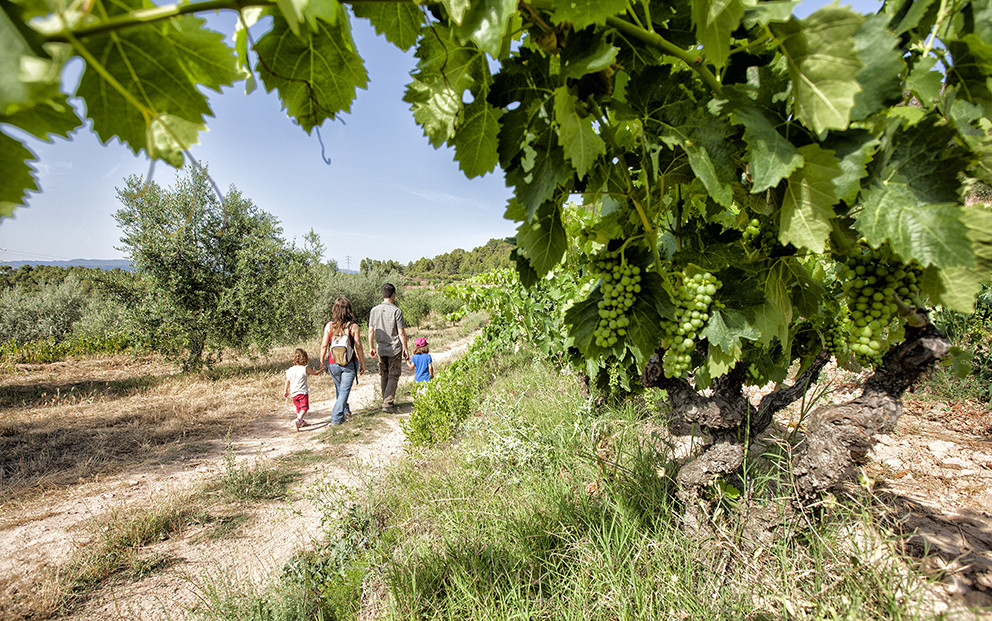
The route is 9 km there and back. If we set out on foot from El Masroig, we leave the car next to Celler el Masroig and go down Carrer de les Pinyeres towards the Barranc de la Vila ravine. We cross the ravine and follow the path to the hermitage. We recommend stopping there and visiting its surroundings, a magnificent viewpoint over the river Siurana from which you can see some villages of the Priorat, with the Serra de Montsant as a backdrop. About three hundred metres further down, we leave the track and take the cart track that leaves on the right, signposted as the Puig Roig Path. Soon the hill of Puig Roig appears ahead of us, flanked on the left by the Serra de la Figuera and on the right by the cliffs of Montsant. Below you can see the fertile vineyards on the banks of the Siurana.
We continue straight ahead and later cross some terraces of vines and olive trees. The path turns left below the terrace wall and enters the forest again. On the right we come across stretches of dry-stone walls that bear witness to the agricultural past of these lands, now covered in pines and scrub. We keep to the same path, leaving on the right the trail that leads to Bellmunt, and reach a terrace of olive trees. Skirting the plot on the right, we go to the other end. There we find a sign showing the way, which leads back into the forest. After passing a ruined little house, we reach the foot of the Puig Roig hill, where large red sandstone rocks guard the entrance to the settlement.
Through explanatory panels and a rope-marked itinerary, you can learn about the environment, the buildings and the inhabitants of this settlement, who were forced to abandon it because of a great fire.