
The character of a place through its arts and crafts
Getting to know a land is not only about knowing where its monuments stand or strolling through the old quarter of its towns. It is also about perceiving its smell, taste, touch and the light that bathes it, in order to understand its farming tradition and savour its recipes, to feel the hands that work there in the trades that fill it with life. Places are also shaped, one way or another, by their inhabitants, and on the Costa Daurada we find great examples.
More information
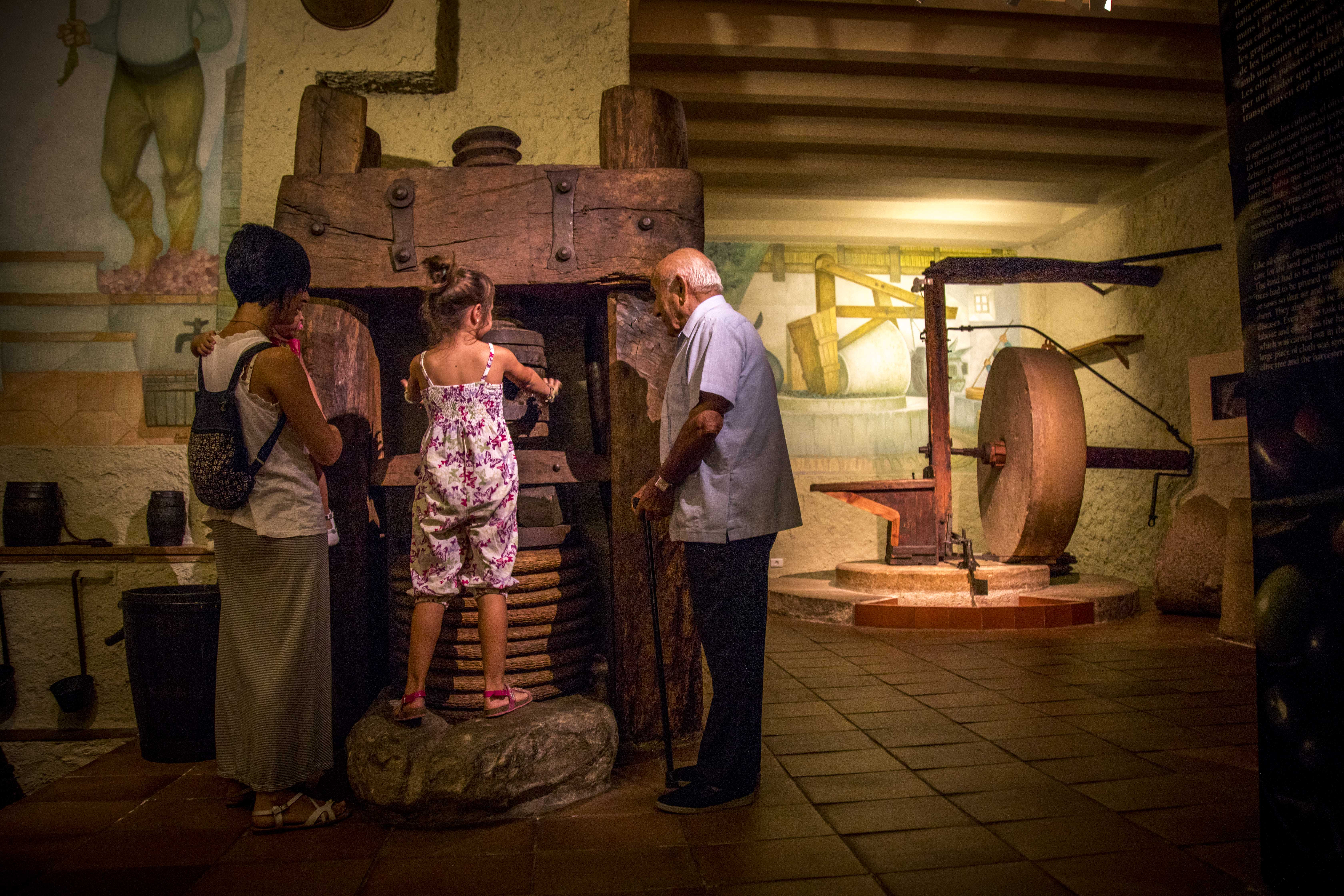
The Museu Terra, formerly known as the Museu de la Vida Rural (Museum of Rural Life), is one of the great jewels of l'Espluga de Francolí. It has recently promoted various initiatives dedicated to encouraging reflection on sustainability and on caring for the land and the trades linked to it, such as farming. It also runs programmes on recycling, on a culture of fire prevention, and on coexistence and the cultural development of the rural world. A facility linked to a cultural centre in Barcelona —the Sala Barcelona— that seeks to be open to the world from the countryside.
If vineyards draw the landscape of the area, wineries cannot be missing. Also in l'Espluga de Francolí is the Celler Modernista i Museu del Vi (Modernista Winery and Wine Museum; closed to the public at certain times of year because of the cooperative's work). Built in 1913 and designed by the architect Pere Domènech i Roura (son of Domènech i Montaner), it is one of the first Modernista wineries in Catalonia. 'The Cathedral of Wine', as Àngel Guimerà called it, well deserves a visit in which, besides being amazed by the structure of the building, you can learn about the history of grape growing in the area, its characteristics and the process of making wine and cava.
Also in l'Espluga de Francolí, around the 1830s, the Fassina Balanyà began operating, a former family distillery that made eaux-de-vie. If you want to know the details of how this very local liquor is made, you can't miss it! You will even see the distillation process live and be able to taste the spirits. You will also see the machinery that distilled grape pomace for more than a hundred and twenty years.
Another option is to visit the Museu i Forn de Vidre de Vimbodí (Vimbodí Glass Museum and Furnace), where you will be spellbound by the workshop demonstrations and can watch how various glass pieces are made using the glassblowing technique. Almost hypnotic. You can also visit the permanent exhibition, with traditional everyday glass pieces, through which you can appreciate how the technique has evolved and be captivated by the skill of the glass artisans and the results of their work.
And we cannot leave anywhere without savouring the taste of its food. Bread is a staple food and, in Conesa, whose old town is declared a Cultural Asset of National Interest, we find the Museu del Forn de Pa (Bakery Museum), which makes this clear. The first records of this bakery date from 1340! At that time the bakehouse was privately owned, but in 1746 it became communal and operated at full capacity until 1924. In the 1970s it became obvious that a place with so much history could not be left to ruin, and it was restored, adding a display of rural life tools to which many of the villagers contributed.
The arts and crafts of each land evolve, change, grow or perhaps disappear, but knowing the legacy of what they once were helps us understand today's reality and how we got here. On the Costa Daurada, fortunately, this legacy is neither forgotten nor erased; quite the contrary, it is preserved and cherished as something most precious.